
Business storytelling at its finest.

IKEA – we either love it or we hate it.

Regardless of your opinion on the ease or otherwise of their flatpack furniture instructions, what I know is that they know their business, their market, and their value inside and out. And they are FANTASTIC business storytellers.

In this 2 minute video the Start Something New commercial tells a complete and compelling story that demonstrates that IKEA:

  1. understands the views of their customers. They know the answer to the questions, “why would I shop at IKEA?”
  2. makes the customer the hero. He comes first, always. The products play a supporting role.
  3. knows that the ‘outcome’ for the customer is crucial NOT the features of the product.  It’s all about what you could become.
  4. gets that how the customer feels when they use their products is central to their business. His belief about his own possibilities changes.
  5. knows how to tap into emotion. There are no product names, branding or anything in site.
  6. helps us to see ourselves in the hero’s story. We are all on a quest to find the best version of ourselves.
  7. knows that the feel-good factor of this story is perfectly aligned with its overall business philosophy. All touchpoints of the business deliver on this.
  8. asks the audience to buy into this story and discover our own along the way.

These are the words published by IKEA with the video:

IKEA invites you to start something new. Because THIS is the moment, let’s get going. Change something, do something different, big or smalls things. What’s important is to start. Get some inspirantion and DO it.

It’s perfect. Perfect for their business and perfect for their customers. And perfectly aligned with my business vision too – particularly given my week ahead.

Are you going to do something different this week? Are you going to get started?


If you need a gentle nudge, want some inspiration, require a handhold to get you going, then maybe you’re lucky number 5 at my retreat. Call me or message me if THIS is YOUR moment.


A surefire way to find time in your week to write.

Writing is an art form, but it can also be considered a science. When writing for business this is particularly true. There are formulas to follow and disciplines to adhere to in order to create the best communication piece possible.

Knowing your audience, grammar, tenses, purpose, plot development, features-advantages-benefits and that sort of thing, are all incredibly important when communicating your value to potential clients. Crafting a good piece of writing requires technique and is essential to getting cut-through and recall. (Side note: You don’t have to write scientifically, or without feeling or personality, to follow these formulas).  There is another super important writing discipline however, and that is the art of mastering TIME. It’s a bit like making money – you need to invest to get a return. Spending time writing every single day will not only improve your writing, but will improve your mindset toward writing – which will ultimately result in better writing.

I ran a straw poll about 6 months ago, as I was curious about the key frustrations business owners have when it comes to content development. I had my suspicions but I always like to check in and have them confirmed.

77% of respondents said FINDING THE TIME TO WRITE was their biggest challenge.

How many of you have said: “Yup, I need a blog on my website because I have so much to say about what I do…I’m going to write something every week…I’m going to post to Facebook three times per day….” and never do?

Regardless of whether you have lofty ambitions as a novelist, or you have a great idea for an online course, or you just want to be able to keep in touch with your fans by banging out a couple of business blogs and social media posts, you need to structure your week to factor in some quiet writing time.

I know you have ‘reasons’ why you haven’t done this before: I’m too busy; I’m burned out; I’m away too much; I don’t know what to say today; I don’t feel motivated today; I spend too much time in front of the computer already; It never sounds quite right; I should be doing money-making activities; It’s too noisy today; It’s too quiet today…

(I can feel you nodding now….!)

But excuses are just that. Lame reasons for not doing the thing you know you ought to be doing. And whilst writing a novel may be considered an indulgent past time (except if you’re a published author with an agent breathing down your neck for the next book!), writing for your business is not indulgent. It is a requirement.

Writing for your business should not be considered a luxury…it’s a necessity.

I hear business owners constantly talk about wanting respect and recognition in their field of expertise. They want to be considered a ‘person of influence.’  And yet they wonder why their competitors are asked for comments or interviews and not them. time-to-writeWell, it’s because they’re not out there. They’re not spreading their word and knowledge wide enough. They’re not vocal enough. They’re not being seen enough.

There is SOOO much noise out there in business land. Everyone is an entrepreneur. Everyone is fighting for a slice of the pie. The only way to really ‘make it’ is to be bloody good at what you do (that’s a given) and to tell people about how bloody good you are at what you do (with grace and professionalism not arrogance!).

Creating and publishing valuable content is the way to do that. Writing stuff about something that you know about. Making it your own. Then sending it out to the world to add value to someone else’s life. It’s the only way to start being perceived as an authority in your space.

I know that time has been one of my biggest hurdles too, (although I do desperately try to walk my talk on this one), so I developed a method to ensure I made time to write and didn’t view it as a chore, or worse, neglect to do it at all.

There are a lot of organisational processes out there, and plenty of time management tools, but here’s what works for me when it comes to writing for my business.

SCHEDULE WRITING TIME IN EVERY DAY AND MAKE IT NON-NEGOTIABLE.

  1. Choose a time of day where you energy is focused and your workspace is calm. Everyone has different rhythms, different energy burning at various times of the day, different tasks they have to get done in a work week.
  2. Schedule 20 minutes of uninterrupted time into your diary at your chosen time of day.
  3. Before you sit down to write, be clear on what your desired outcome is, or what piece of writing you are going to tackle.
  4. When you sit down, set a timer and write furiously for 20 minutes and then stop, regardless of where you are at. (The reason for this is to train yourself to use the time wisely by throwing everything into it and maximising your output without over-stretching it.)
  5. Follow this process, daily if possible. If that feels unachievable, set yourself 3 days in the week where you follow the process. You may find you actually enjoy it (and become very productive) so you can work up to more writing days in your week.

My time is night time. It’s quiet. The kids are asleep, the cat has settled, my phone has stopped ringing and I’m calm. My imagination is better at night time and my creativity is flowing.

I tried getting up early, when my husband does, to write at dawn, but it just didn’t work for me. My brain was too foggy and I resented not being in bed for those few extra zzzz’s. I spent the rest of the day with tired eyes and a scattered brain. I also tried writing at lunchtime, but I was either too involved in client work and felt like writing for myself was an interruption or I was hungry (and I don’t write well when I’m hungry). I even tried writing for one whole day in my week to knock over large pieces of content…but that was just too taxing and also felt like an interruption of the hours I could be getting paid for.

I really struggled with getting this right in the beginning stages of my business.  I felt guilty about my lack of focus and hated myself for failing at all these techniques. I abhorred my laziness and was pissed off at my easily-distracted nature. But the truth was I was just damn scared to start writing and put myself out there in any kind of regular fashion; I was doomed to fail from the outset. And it was just stupidity. Some crazy blockage. I wrote reams and reams of verbose diatribe in my teens and twenties. I have degrees in Literature. I know how to write, for goodness sake! But for some reason when it came to writing for my own business I just couldn’t do it.

(Sound familiar?)

So here’s the thing. If you follow the above process, I guarantee you, you will get truckloads done.

Why?

Because focusing on one task is completely possible – and probable – for 20 minutes.

Even when you’re tired and busy, 20 minutes is doable. Consider that it’s really only once or twice around the water cooler in corporate days terms. And seriously, if you can’t find 20 minutes in your day, you need to sort your stuff out – there is TOOOO much going on.

The key is to stick to your allotted time and to stop after the timer has gone off. I know that if I kept writing, I’d be overwhelmed, and ultimately this would stop working for me. I may feel great on the days I wrote for an hour but then really crappy on the days I couldn’t manage 10 minutes. So, find the length of time that’s right for you and stick with it. If you find that 20 minutes is too long make it 15 – but commit to it.  The more easily you can fit this time into your schedule, the more successful it will be for you. You’ll get much more achieved and you will reap the benefits big time by expanding your profile through your content.

So whether it’s a blog, social media posts for the week, research papers, case studies, a novel, or marketing materials, think about how much you could achieve it you just gave yourself a calm, happy 20 minutes each day to write….

Don’t undervalue DOING

Planning is necessary, thinking is paramount, but doing these without action is useless.

There’s always a client you could follow up.
There’s that new ad you could write.
Oh, and there’s that survey waiting to be sent.
There’s a product you could trial.
There’s a webinar you could watch.
Oh, and there’s that training you could do.
There’s those new contacts you should follow up.
There’s that copy you could test.
Oh, and that super important observation you might take action on.

Each of these presents an opportunity to learn something that could change everything.
But you have to get started to see that change.

All the plotting and planning in the world won’t mean anything if you don’t take action.

Don’t wait for the moment to be right.
Don’t wait for the mood to be perfect.
Don’t wait for the stars or moons to align.

An imperfect first step has more chance of success, growth and creating propulsion than standing still.

Pick one thing and start today.

Be a change maker not a change seeker

I’ve been thinking a lot lately about the changes that have happened in my business and the improvements I would still like to make. I reflect on these two things often.  They tend to come up for me when someone asks me my story, or wants to know more about what I do.  It seems that many small business owners I speak with feel the same; there always seems to be a need for stretching, improvement, and change. The thing is that often we’re just not sure what’s missing, how to begin to effect the changes or even where to start.

To make change happen you need three key things:

  1. The vision to know where you’re going,
  2. The skills and resources that enable you to get there
  3. A plan to drive it forward.

There’s a big difference between people who seek change and people who make it happen – the latter understand where they want to go and why, and they have a strategy for getting there.

And key number four? The change makers rarely do it alone.

This kind of work is what I love to do for business leaders from solo startup to established expert. I do this work with heart, skill and experience in my corner. One-on-one consulting is the most effective method, although I also run beautiful group immersion retreats and technique workshops. Each has its own benefits.

If you want to build a meaningful business that becomes a beloved brand you need to unlock the value of your story. The power that lies within your own words is immense; use them wisely in your marketing and you will connect with people in a way you never knew possible. When you learn how to look back and connect the dots of your own history, your present and your future will become far clearer.

If you would like to become a change maker rather than a change seeker, then I’d love to be by your side.

If you would like to work with me on a one to one basis, please contact me for details on terms.

I’m also opening up registrations for the July (1-4) and October (21-24) Writer’s Retreat. More retreat info can be found here.

I am excited to have the chance to work with you, to help you differentiate your brand, build the business you want and to see your ideas fly.

The horror pedicure and other important tales

So. THIS happened today. You know, just your average morning in the Johnson household where the weird and wonderful often occurs at the most random and often awkward of times.

This week’s episode of “not what you expect first thing Sunday morning” is brought to you by Master 4 who decided it was time to create a ‘salon’. His salon services included makeup and nail polish and there was a lovely cushion to sit on and some rather untidy, but somewhat arty, shredded paper for my feet to rest on. Apparently the paper was to stop mess getting on the carpet….(why did I ever consider he could make THAT call??)

So the process was quite formal and really rather organised.

After having my appointment written down with my name and phone number and preferences recorded (you know, all the important stuff like tea versus coffee, cake versus muffins, pink polish versus blue), my name was then called by the salon master’s able assistant (Miss 7) and I was placed on the cushion to begin my treatment.  Let’s just say it was a whirlwind experience. I actually didn’t see them coming at me they were that swift. They were like a well-oiled machine. I had a blush brush across my lids and a nail polish brush across my toes before I knew it (and could protest). But all the while, Master 4 sang and hummed and made beautiful ‘background relaxing music’ for me to enjoy, whilst Miss 7 chattered incessantly about the weather, the latest movies and then spoke about her children and her pets and asked if I had children and where they went to school.  I even got the odd calf squeeze from the toenail technician to make me feel better after a long week at work! Where had they seen and heard all this before? Gee, I wonder! It was a marvellous re-enactment of a myriad things they’ve experienced, salt and peppered with their own creativity and desires to be important grown-ups.

How could I say anything awful about the execution when the process was so divine?

Within 7 minutes, I was made up from top to toe. I had shimmer gel and blush and eye shadow on every inch of my face. I had bronze nail polish on my left hand (yes, ‘hand’, mostly) and pink on the right. And the piece de resistance? The toe nails. An eclectic mix of sparkly aqua with a dracula blood red overlay on the left, and aqua with dramatic death black and some highlights of pink confetti on the right.

Who wouldn’t love this look, right? Apart from appearing as though my toes have been through the mincer, or possibly were used as a prop for a horror film, I actually really love what the kids did to me. Ordinarily I would be like, ‘yup, that’s great, but that’s enough now. I need to get this off and go do ….” But today, even though I had a coffee date half an hour later, I just rolled with it. Why? Because they were focused, creative, telling a story and just so lovely to watch.

I’m really aware of the moments, the stories, around me now; but I wasn’t always.

I make an effort to listen more closely to the tales that are told, the lessons that can be learnt and the moments that need to be savoured. I pick up snippets of conversations in public places and my brain instantly creates blog titles from them. I am conscious of what’s going on in my head versus in front of me. I am consistently finding ways to pluck gems out of conversations and create new scenarios that can be written about, retold, made relevant to the people I help. I make a concerted effort to do this now, because it’s really easy NOT to do this. And it’s really easy to miss the point, miss the day, the year, and miss the life.

Whether it’s my kids playing or a friend rejoicing or a family member complaining, I’m more conscious of finding the second layer of meaning in the exchange. I don’t get all weird and agonise over every word in every conversation, but I do spend more time now analysing the really big convos. Why? There always seems to be more to the story than first relayed and, truthfully, I just find that really intriguing.  I realised that my kids are usually teaching me something or asking to be taught something when they role play. And when a friend bitches and moans about their kids, there’s usually something else going on for them. And when someone boasts about their achievements it’s usually a cover up for some other hurt that needs mending.

What I know is that storytelling comes in many guises: black and white on a page; grey and murky in the shadows.

And when you’re telling your business story, you need to let people know that whilst you’re aware there are shades of grey (50 in fact!), black and white is definitely more palatable. Be clear with your message. Be clear with your value. Be absolute with your offering. Nobody buys grey. They buy black or they buy white. But grey is just ‘meh’.

So, if your special gift is spooky horror pedicures – let the people know. They’ll either want one, or they won’t!

Why the brain loves stories

Since the first cave paintings were discovered, over 27,000 years ago, telling stories has been used as a fundamental means of communication.  Now, as well as historical evidence, there is scientific evidence to prove that we humans actually crave stories, like a child may crave sugar! Recent research in neuroscience has revealed that our brain is actually hardwired to respond to a story.  So, in the words of a famous sugary advertiser, why is it so???

Why the brain loves stories

We all enjoy a good yarn – around the campfire told by your grandpa, at the cinema being delivered by Hollywood or at the bar being recounted by your mate. But why is it that we feel so engaged when we hear a narrative about events?

It’s actually quite simple. If we listen to a presentation with boring Powerpoint points, certain parts of the brain get activated. Scientists call these Broca’s area and Wernicke’s area. The messages hit the language processing parts of our brain, where we decode words into meaning, and that’s it. Nothing else happens.

When we are being told a story though, things change dramatically. Not only are the language processing parts in our brain activated, but all other areas that we would use when experiencing the events of the story are too. The feelings, emotions, physical reactions bits. Pretty cool hey?

The thing is, humans at their very base are social beings who regularly interact with strangers – at the supermarket, the park, a restaurant, a workplace. Stories are an effective way to transmit important information and values from one individual to another. Stories that are personal and emotionally compelling engage more of the brain and are thus better remembered. They get to the core of us as humans, far more readily than simply stating the facts.

There are two key aspects to an effective story

First, it must capture and hold our attention.

Second, it must transport us into the characters’ world.

The way to keep an audience’s attention is to continually increase the tension in the story. When you maintain attention, the brain produces symptoms similar to those of arousal – the heart and breathing speed up, stress hormones are released and our focus is high. In story terms, once it has sustained our attention long enough, we may begin to emotionally resonate with the story’s characters. This is where the ‘transportation’ begins. (Think sweaty palms as you watch James Bond fight with a villain on top of a speeding train! Or an aching of the heart as the unrequited love of the heroine plays out in front of you.)

Transportation is an amazing neural feat. We may be watching a movie or reading a book, knowing intellectually that it’s fictional, and yet our brain simulates the emotions we intuit the character must be feeling and then we begin to feel those emotions too.

Stories bring brains together

Emotional simulation is the foundation for empathy. It is particularly powerful – and useful – for social creatures such as humans, as it helps us quickly decide whether those around us are happy, sad, angry, dangerous or friendly. This mechanism keeps us safe but also allows us to rapidly form relationships with a wide variety of members of our species – more so than any other animal. By knowing someone’s story, where they come from, what they do, and who you might know in common, relationships with strangers can be formed quickly. And when people come together, amazing things can be built, created, designed, and imagined.

How we learn through stories

As it turns out, not all stories hold our attention nor transport us into a character’s world. (Remember those tedious books you were forced to read in high school and the hideous training videos you were forced to watch at your corporate sales training day?). NOT ALL STORIES ARE CREATED EQUAL!!! The most engaging and successful stories require the ‘dramatic arc’ structure. You start with something new and surprising then increase tension by introducing difficulties that the characters must overcome, often because of a failure in their past, and then you lead up to a climax where the characters must look deep inside to overcome the impending crisis. Once this transformation occurs the story resolves itself. This is the perfect story framework and one that tends to leave its message behind more memorably.

How stories connect us with strangers – and ourselves

Stories can motivate us to look inside and make changes to become better people. We can make conscious choices about the stories we choose to create, believe, follow and live out. By the same token, we have free will to change a story, mid-narrative, if it doesn’t suit us any longer.

Stories have huge power to create empathy and propel us to take action we otherwise wouldn’t; we can find ourselves stepping into a zone well beyond our usual comfort. These stories can lead us to ‘helping’ behaviours when we engage with others, which generally makes us humans happier. Caring for strangers is advocated by many philosophical and religious traditions for good reason – it helps give our lives purpose and drives us forward.

And so it is, that by listening to the stories around us, we can find ourselves interacting with people and places we may never have dreamed or conceived of. As a wonderful by-product, we may find ourselves doing work and living a life we never knew possible, creating a deep connection with ourselves that is invaluable and precious.

I confess to telling untruths about my family…..

For the past few months I’ve been telling myself some stories about my family. And unfortunately, a number of them have been negative and frankly untrue.

“Master 4 is just that way at the moment, it must be the testosterone…”

“That’s just Miss 7’s personality, it can’t be helped….”

“That’s just the way we parent, it’s all we have time for….”

“Maybe we’re not meant to have a smooth ride….”

“I can’t help it, I don’t know any other way right now…”

And so on.

It’s not great. It’s not cool. And I’m not really proud of it. But I’ve thought it, felt it and said it.

What happened on our recent family jaunt up the east coast was very interesting however; my thinking about my family shifted markedly. Master 4 isn’t THAT way, or any other way in fact – his behaviour was just that way in that moment. And Miss 7 isn’t this type or that type of kid, she just behaved that way as a result of the knowledge she had at that point in time and the triggers around her.  We aren’t any type of people or family, we have simply been behaving a certain way as a response to the pressures, emotions, events around us. And over the last 6 days, we moved from behaving in a very particular way, to behaving in a vastly different way.

IMG_7732Days away from the home, properly disconnecting from work and renovations, and genuinely connecting with each other did amazing things for our behaviour and interactions with each other.  And it didn’t take much to do it. In fact, there was no plan for it to happen, not even a conscious thought or hope that it might happen, but happen it did.

You see, we had a very busy year last year with a number of high stress points and challenges.  We also had some amazing celebrations which I guess in many ways added to the rollercoaster of emotions.  My husband (Simon) and I both spent a lot of time travelling, which in and of itself is not stressful (in fact we both love it), but the planning for it to occur with two children to look after, was.  We also lost two dear pets rather suddenly, undertook a bunch of renovations on our home, and dealt with some rather ordinary family health issues. My business ramped up enormously which, whilst fabulous, meant I had to (and wanted to) find more hours in the week and therefore had to lean more heavily on my already slim support systems – something I’m not very good at doing (it’s in my 2016 plan to figure this bit out!). I also felt the pressure to be there for an increasingly demanding school and after-school activity regime and all that’s involved with that.  My kids needed me more as their emotional requirements changed, and yet I felt less and less available.  My parents also needed to lean on me more and yet I didn’t know how to make that work, given distance and time. My head was elsewhere and everywhere, trying to be everything and everyone. And Simon was the same. He was asked to lead a high profile and extensive project which would see his responsibility and time requirements increase, and along with it, his stress levels. He barely got home to see the kids before bed and was gone before they woke. “When’s daddy coming home?” was a nightly question to be faced with, and “I don’t know” was often the unsatisfactory answer.  They needed him, and didn’t get him, so they needed me more. And I simply didn’t have the reserves.

teaching fishingAnd so our weekends were a blur of trips to Bunnings, maintaining the house/garden, running to activities, a hurried visit to friends, late night working sessions and too many wines (under the guise of having a life and enjoying ourselves!), all masked as ‘family time’.  We were often tired and restless and resented the kid’s need to be with us constantly and got antsy about having no time to get anything done. And we spent too many moments saying “go and amuse yourself please, just for an hour or so,” and then got grumpy when the kids were fractious, fighting and hanging off our heels. No fricking wonder!

Craziness. And not at all the vision I had of my ideal life.

So it was a lovely surprise when driving home last night that Simon and I both reflected on the amazing change of behaviour our roadtrip had created in our family.  We didn’t know it would happen, we didn’t do anything special. We didn’t even try. We simply relaxed and enjoyed each others’ company. Importantly, we were present.

Lucy learnt how to backflip in the pool and catch a wave on her boogieboard. Simon helped her and she beamed.

Ollie learnt how to catch a fish and play cricket on the beach. Simon helped him and he glowed.

We walked, we swam, we cooked, we rode, we found crabs and jellyfish and squid and stingrays. We lay still and watched the clouds. We talked, we shared, we read books, we watched ballet, and we moisturised each other’s warm skin. And it was heaven. It was how I remember it was when I was 7. THIS was my family. THIS is who we are. IMG_7678

They need us just to be present. They need us to connect deeply when we talk with them, to laugh loudly when we’re learning, to give all of our body when we’re playing.

We’re full to the brim of this goodness right now. I know it may not last as the school year starts, the workloads increase, and the challenges arise, but for right now it fills me up and I’ll hang on to it for as long as I can. What I do know though, is that we are not any particular type of people, we behave in certain ways at certain points in time, in response to events and people. My aim is to respond more regularly with presence.

And with presence comes more positive and powerful stories…..

The recipe for a tasty media kit

Clients often ask me about producing a media kit for them. Actually, usually the first question is: ‘what is a media kit and do I need one?’ Nine times out of ten the answer is YES. Why? Because over the last few years, media kits have moved from the more traditional worlds of print magazines and corporations to become a key sales and marketing tool for bloggers and small businesses.

If you’re not familiar with a media kit, it’s basically a document that businesses use to promote themselves and sell their services to potential clients. Whilst magazines use media kits to sell spots to advertisers, bloggers and entrepreneurs use media kits to sell themselves as well as advertising on their sites, sponsored posts and brand collaborations. Service-based businesses, such as photographers, use media kits to promote their packages.

On the surface a media kit may seem a little fancy, tricky or open-ended but that’s part of their appeal. There is no set formula. A media kit can promote whatever a business owner feels is their key selling point. They can also be presented in whatever way you wish – as a simple pdf document, a landing page on your website or a fully designed digital flipbook.

As for what to include in your media kit, here are the most common items:

  • An introduction to yourself and your business

This is your chance to explain who you are, what you do and for whom. It’s your chance to demonstrate what purpose your business serves. Whilst you should know this stuff intimately, it is often the hardest part to write about. Writing about and promoting ourselves can be really difficult – we’re often just too close to it to make it read well. Hint: Don’t get caught up wasting time on this step. Hire a copywriter to bang out your professional bio; an outsider can view you objectively and highlight your magic without that layer of self-consciousness. It will be money well spent.

  • Your mission

Sometimes known as a ‘manifesto’, this is your way of differentiating your business from the competition and explaining what it stands for. This step is imperative. Unless you have developed something that is absolutely rare, you need to make yourself stand out from the myriad other choices that customers have. There are a squillion coaches, designers, nutritionists, chiropractors, financial advisors, real estate agents etc etc, so what makes YOU so special? You need to cut through the clutter here. Unique is great – don’t be afraid to be different!

  • Testimonials

Testimonials are an excellent way to let people know how wonderful you are without sounding full of yourself! Use other people’s words. Regardless of whether they’re from clients, suppliers, partners or subscribers, testimonials add a sense of credibility to your business. They also give potential clients a sense of comfort that someone else has invested in you previously and received great results. People want to feel safe and justified in their choices, and testimonials help them do that.

  • Frequently asked questions

If you are repeatedly asked the same questions about what you do or how, stop and take note! By including a FAQ section in your media kit you will greatly reduce the upfront email banter that comes with new enquiries.

  • List of notable clients

As with testimonials, a list of notable clients can help the Nervous-Nellies feel comfortable that you know what you’re doing. Some of your potential clients may have never worked with someone in your industry before so they want to be sure they’re making a sound decision.

  • Services offered

Highlight all of the services you offer, with particular emphasis on the things you really LOVE to do. It’s even better if these things are not run-of-the-mill – you’ll pique interest more quickly that way.

  • Packages and rates

If you’re not great at talking about money, clearly listing your services with base-level pricing (‘starting at’ or ‘from’) can be an excellent way to help people understand what the ballpark investment is to work with you. Be clear about what they receive for that price and what else is on offer as ‘add-ons’. Don’t surprise people when it comes to money – don’t be embarrassed or ashamed of your pricing either. If you can say it out loud in the mirror, and believe in the value you deliver, then you can put it on paper.

  • Statistics

If you offer a service where stats (read: traffic to your website, social media engagement, advertiser results etc) are important, then include these in the media kit.

  • Process

If you have some kind of process you follow when you engage with a client include this. It can help demonstrate the value you offer and the reason you get consistent outcomes. By giving potential customers a glimpse into this behind-the-scenes world, you are helping them understand the work you do and perhaps also helping to justify your rates!

  • Contact information

This is absolutely imperative. Offer all the different ways someone can get in touch with you: social media handles; email address; website address; phone number. Make it as easy as possible to book you!

  • Recent Press publications/articles

Copies of recent press coverage are highly appropriate for a media kit. This may include article reprints, online and offline press, interview transcripts and audio or video files of speeches/performances/interviews.

  • A sample news story

This is your chance to guide the media or your reader. Some editors will even print it verbatim; a ready-to-print article is an easy way to fill up space with little effort.

  • Other items may include:
  • Awards
  • Nonprofit and community-service involvement
  • Logo artwork
  • Photos
  • White papers
  • Schedules of upcoming promotions and events
  • Significant statistics specific to your industry, demographics and target audiences
  • Samples or examples
  • Giveaway information
  • An order form

The Key Ingredients to Being Noticed

If your intention is to be published in a popular publication, you need to really make your media kit stand out. Busy editors may sort through piles of media kits each day! So, to get some action on your kit, by either an editor or your target audience, you’ll need to package your materials in a unique and professional way.

media kit 4 media kit 3 media kit 2 media kit 1

Follow up is also critical to being noticed. You’d be surprised how many media kits get sent out and then nothing is done afterwards. First up, you need to be sure your recipient actually received your media kit. A follow-up call also provides the perfect opportunity to answer any questions or schedule a meeting. Use this opportunity to build relationships with your intended audience – it should be considered part of your marketing strategy.

What next?

The challenge is always just to get started. Do yourself a favour though and don’t reinvent the wheel. You probably have most of this content already written in various places – your website, your quotations, your proposals, your social media accounts – so just collate it and give it a polish.

Typically, the media kit doesn’t have to be as fancy as people think. Those requesting media kits just want information–not necessarily glitz.

If you would like a hand putting together your media kit, you know where I am!

Create the perfect ending to your story: 5 essential elements

‘Nobody reads a book to get to the middle.’ ~Mickey Spillane (American crime novelist)

Whether you’re writing a book or writing a marketing piece, you need to ensure your ending is rewarding for your reader. After all, they have come on a journey with you through the beginning and middle to get there! It should have the most drama, tie up the loose ends and leave the reader with something memorable.

Here are five tips to ensure your reader will want to finish reading the story AND be excited about reading your next story

  • Narrow your hero’s options.

A sense of the inevitable needs to be present. Your hero (which will be your ideal client in the case of writing a marketing piece) should start to realise that the path to his or her goal lies in only one direction (your service or product) – usually the one he or she has been trying to avoid. Allow them to try other pathways (competitive offerings), but make sure they fail (show them the pitfalls of these options). Typically the hero’s rival (the devil on their shoulder) will rear their head again here, creating obstacles as a test.

  • Make everything worse for your hero.

Keep the reader wondering whether or not your hero will achieve their story goal. Suspense is a great page-turner. The worse the story gets and the fewer pages your reader has left, the more anticipation you can build. The end of your story should contain many more scenes of action than reflection.

  • Resolve all story lines.

Your content piece, whether a full blown novel, blog or eBook, should be written from the beginning with the end in mind. Each ‘scene’ needs to be building and carving out a plot that leads to the end game. And each story line must resolve itself. The most important story line should last the longest, thereby keeping your reader in suspense for longer. Don’t go introducing any new characters or ideas in the last quarter of the story. The most satisfying stories are those where the central conflict is resolved. It doesn’t necessarily have to be a happily-ever-after ending but readers do like to be left with some hope.

  • Tie up loose ends.

Try not to leave your reader wondering what happened to any of the characters or be left with unanswered questions.

  • End on a strong note.

Don’t try to be too tricky here by throwing in a red herring; the most important thing is to create a sense that the story has really ended. Readers like to know that the journey has made sense all along and that the hero has come to the conclusion they have because of choices they made early on in the story. If we’re still there at the end, it’s because we are invested in the outcome. The final impression of your writing should be positive. Trickery can leave a reader feeling cheated and not inclined to come back.

Is your sign-off a turn-off?

I asked some people in my Facebook community a little while ago about how they signed off their emails and whether they had put much thought into the language they used. The question was prompted by an interesting email sign-off I had received the day before: ‘To Higher Conversions, Clay Collins.” He’s the dude who sends me information from Leadpages, the landing page application I use.   This sign-off is perfect for him and his business – helping people creating landing pages that convert visitors to customers – and is highly memorable for that reason.

Most of the people who responded to me hadn’t put much thought into their own sign-off. They were simply using the same words they had been using forever – mostly as a layover from corporate days.  It got the creative juices flowing – mine and theirs – as to better ways to sign off emails to their clients and prospects.

But why is a sign-off important? Why should we even bother thinking about it? Because how you sign-off or close your email sets the tone for the email and leaves a lasting impression on your reader.  It can also make or break the intention, and therefore ‘success’, of your email.

Obviously there are different styles of writing for business emails versus personal ones, and so too should your sign-off be different. There is one thing that EVERY sign-off requires however – your name! Whether it’s first and last or your first name alone depends on the level of formality.  Usually the first time you write to someone you will include both your first and surname; subsequent communications will probably only require your first name. And if you’re writing to a close friend or family member you may even use your nickname.

The sign-off itself will also depend on the overall tone you are trying to achieve and also possibly the intended meaning of the email content. For instance, you wouldn’t use “Yours truly” in a business email; it’s too familiar and warm and usually reserved for close relationships.  On the other hand you wouldn’t simply use “Regards” if you were trying to build a relationship with someone and sell them your counselling or coaching services! It’s highly unemotional and could be considered terse.

You may like to consider using a sign-off that is reflective of your personality or individuality (“Sparkles and light” if you’re a cosmic cat!).  I like to encourage clients to use words that reflects their business value or offering. For example, a naturopath may use “Yours in wellness”.  A life coach might use: “To your health and wealth”.  A travel agent might say: “Here’s to great adventures.”  There are endless possibilities – most of which will be far more meaningful and memorable for your reader, (whilst still being appropriate), than boring old “Regards” or “Best wishes”.

Here are my four rules for signing off on emails:

  1. Don’t include quotes. They can make the reader question why you’ve chosen that particular quote and therefore prove to be a distraction.
  2. Avoid oversized logos. If they are too big, they draw the eye away from the message.
  3. Include your title and contact info, but keep it short. In most business emails, you’re doing the person a favor by sharing your vitals, but keep it minimal. A link to your website or Facebook page is ok but avoid a shopping list of links promoting your projects and publications.
  4. Include some kind of sign-off, not just your name. The function of a sign-off is to signal the end of a message. It helps direct the reader and clearly communicate your message.

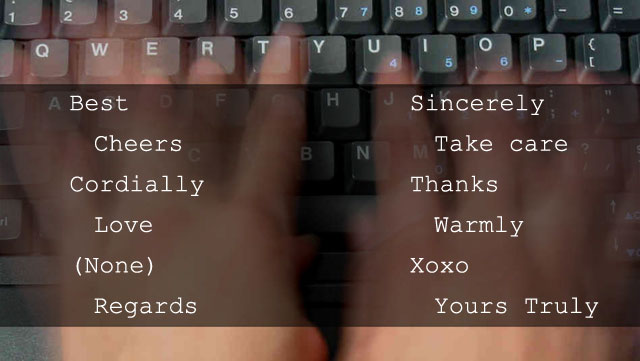
Here is a list of some common and not-so-common sign-offs with a bit of commentary attached!

Best – Totally safe but can be a little lonely on its own.

All the best – This is better and harmless. A good one for a wide variety of recipients.

My best to you – A little old-fashioned.

Best Wishes – It’s a little like a birthday card sign-off from your work colleagues but it’s not bad.

Bests – Too fussy and terrible if you have a lisp!

Best Regards – More formal than “Best wishes.”

Regards – Fine and helpfully briefbut a little dull and not very warm.

Kind regards – Warmer and better than plain “Regards” if you want some formality but are building a relationship. I use this often.

Rgds – OK if you’re sending it from your phone but it wouldn’t kill you to type the other 3 letters!

Warm Regards – I like this for a personal email to someone you don’t know very well, or a business email that is meant as a thank-you.

Warmest Regards – As good as Warm Regards, with a touch of added heat.

Cordially – Very old fashioned and always reminds me of cordial…the drink…from the 70s…

Take care – In the right instances, especially for personal emails, this works. I use this when the email content warrants it.

Thanks – I’m not convinced this is a sign-off as such, but it would depend on the content of the email.

Thanks so much – I use this when someone with whom I have a business relationship has put time and effort into a task or email.

Thank you – More formal than “Thanks.” I use this sometimes.

Many thanks – I use this when I genuinely appreciate the effort the recipient has undertaken.

Thanks for your consideration – Quite formal, but would definitely work in the business context where you are submitting an offer, idea or proposal. Be careful though as it could be seen as almost asking for a rejection.

Thx – I don’t approve of this in emails but in a text between friends and familiars it’s ok.

Hope this helps – I use this one when I am offering solicited advice to help the recipient.

Continued success – You’d want to be sure they had initial success before using this!

Keep up the good work – As above! This can be useful however, if messaging a coaching client who has sought feedback on something from you.

Be well – I find this  a bit grating. Not appropriate for a business email.

Peace – Suitable if that’s your business or personality, but pick your audience.

Yours Truly – Very much an old fashioned way to sign off. Think: your 9 year old pen pal or estranged auntie!

Very Truly Yours – VERY VERY old fashioned.

Sincerely – OK for some formal business correspondence, but reeks of lawyers and accountants to me.

Yours Sincerely  – Same as “Sincerely,” but even more so!

Looking forward to your reply – This works when you genuinely want a reply from your recipient!

Cheers! – I use this sometimes for familiars. It’s quite a British/Aussie thing. Be mindful of using this with Europeans or Americans.

Have a good one – Again, very Aussie. Be mindful of how this could be misconstrued too. Have a good what???

Ciao –  I like this in playful personal emails. But then I love everything Italian!

-Your name – Terse but ok except if it’s an initial email. I’d always try to combine an actual sign-off with your name.

-Initial – Good if you know the recipient really well and even fine in a business context if it’s someone with whom you correspond frequently.

Love – Way too informal in the business context for me.  This could be off-putting for some.

XOXO – Not a good idea in business emails. Save the kissses and hugs for your bestie or partner.

Lots of love – Only for personal emails.

Hugs – It’s hard to imagine this in a business email but it’s great when you’re writing to your granny.

Smiley face – Emoticons are increasingly accepted, though some people find them grating. Be mindful that they may reproduce incorrectly when read through some email applications so will appear as [smiley face] rather than the actual picture of a cute little yellow face.

Take it easy – Highly informal and may not be read as intended. Be careful using this with people you don’t know well.

See you around – Same as “take it easy”. Are you literally going to see them around or figuratively?

Sent from my iPhone – This used to bother me but I realise that it can explain brevity and typos (which I hate, regardless of the device being used!). I would prefer people don’t know whether I’m at my desk or on the move, so I don’t use this.

Typos courtesy of my iPhone – No excuses peeps!

Pardon my monkey thumbs – Same problem here.

Please consider the environment before printing this e-mail. – A bit preachy and a bit early 2000s. Who doesn’t know that printing uses paper?

Lengthy disclaimers – We’ve all seen these and ignored them, though I understand that many companies require them.


The final word:

Your closing needs to be inline with the overall tone and demeanour of your email. If it’s completely at odds it will be jarring and will leave the reader wondering what they’re supposed to do or feel next.  The sign-off is the icing on the cake to ensure your message is received as intended and there is no room for misunderstanding.

By taking your time to choose your words carefully, your sign-off will become another demonstration of how wonderful it is to communicate with you!